Kraków Main Market Square and Cloth Hall: A Visitor’s Guide
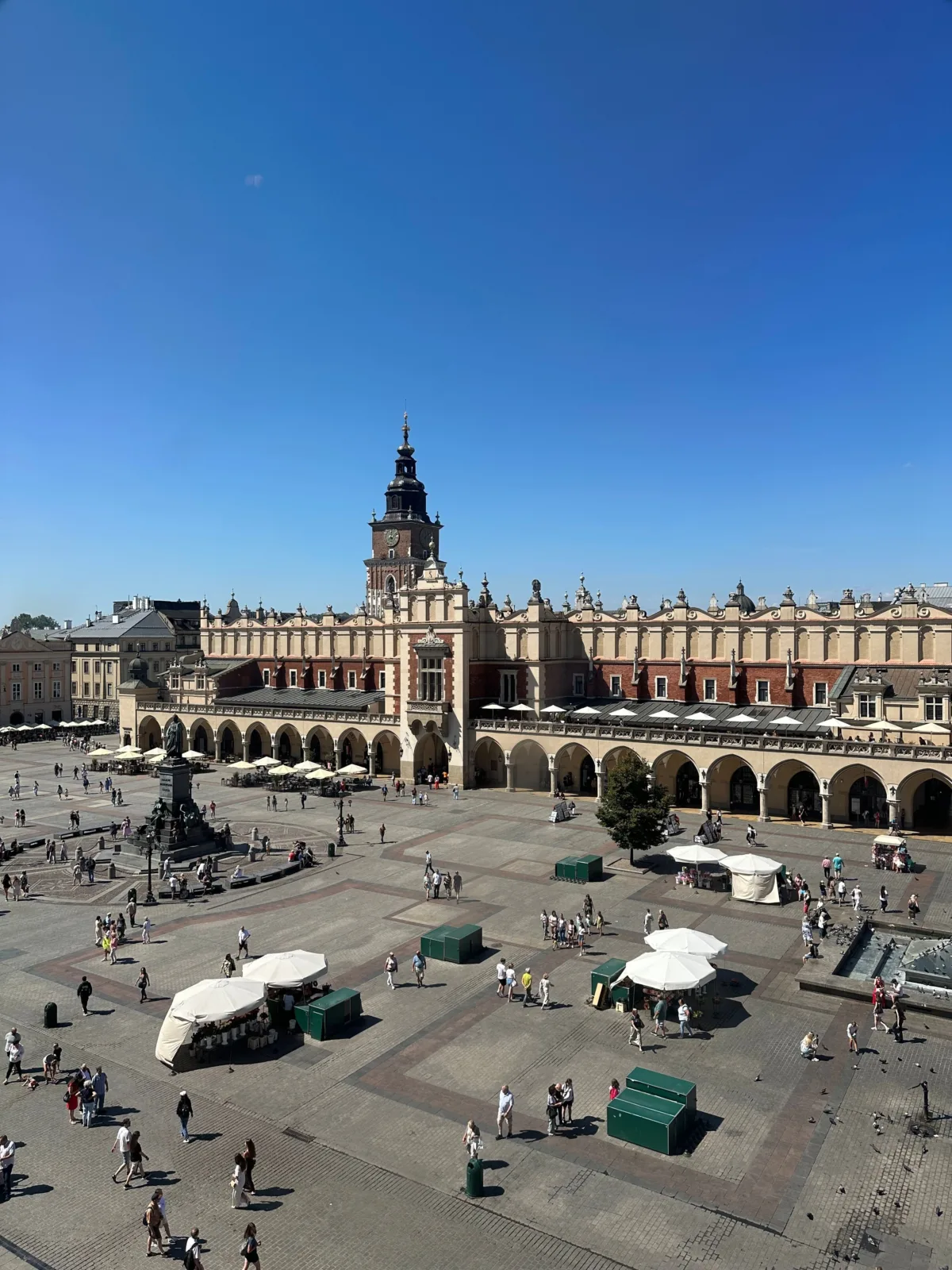
The Main Market Square — Rynek Główny — is the heart of Kraków and the largest medieval town square in Europe, laid out in 1257 and almost unchanged in shape ever since. Ringed by townhouses, churches and cafés, with the Cloth Hall at its centre and St Mary’s twin towers rising above, it is where most visits to the city begin. This guide covers what stands on the square and how to make the most of it. For the wider picture, see our Kraków travel guide and things to do in Kraków.
The square itself
When Kraków was granted its town charter in 1257, surveyors set out a vast square — about 200 metres on each side — with streets running from it in a regular grid that still orders the Old Town today. For centuries this was the city’s marketplace, stage for royal processions and public life. The medieval stalls and weighing houses are long gone, but the proportions remain, and the square is now one great open space for strolling, people-watching and pausing over coffee. Horse-drawn cabs wait along one side, flower sellers have traded at the foot of the Adam Mickiewicz Monument for generations, and the whole Old Town around it is a UNESCO World Heritage site.
The Cloth Hall (Sukiennice)
The long arcaded building down the middle of the square is the Cloth Hall, a Renaissance trade hall on the site of the medieval cloth stalls. Its ground-floor passage still works as a market — souvenir and craft stalls selling amber, woodwork and folk goods — while upstairs the Gallery of 19th-Century Polish Art, a branch of the National Museum, hangs the great canvases of Matejko, Chełmoński and their contemporaries. Check current opening hours and tickets on the National Museum site before you go.
St Mary’s Basilica and the hejnał
On the corner of the square stands St Mary’s Basilica (Kościół Mariacki), a Gothic church with two famously unequal towers. Inside is the monumental wooden altarpiece carved by Veit Stoss in the late 15th century, one of the masterpieces of European Gothic art. On the hour, every hour, a trumpeter plays the hejnał from the taller tower — a short melody that breaks off mid-note, recalling, by tradition, a medieval trumpeter cut down by an arrow while sounding the alarm. It is broadcast across Poland at noon. You can climb the tower in season for a view over the rooftops; hours are limited, so check on arrival.
Under the square: Rynek Underground
Beneath the square, the Rynek Underground museum (Podziemia Rynku, part of the Museum of Kraków) leads you through the excavated medieval market level — foundations, trading stalls, coins and everyday objects — brought to life with reconstructions and projections. It is one of the city’s most rewarding museums and especially good in poor weather; timed tickets sell out, so book ahead via the Museum of Kraków.
Around the square
A few more landmarks complete the picture. The lone Town Hall Tower is all that remains of Kraków’s medieval town hall; you can climb it for another view. The small Romanesque Church of St Adalbert, one of the oldest in the city, sits almost swallowed by the square’s later paving. And the Adam Mickiewicz Monument, honouring Poland’s national poet, is the city’s traditional meeting point — “see you at Adaś” needs no further directions.
Practical tips
- Getting there. The square is the centre of the Old Town and entirely pedestrian; walk in from anywhere within the Planty ring, or take a tram to the edge of the Old Town and continue on foot.
- Cost. The square itself is free; the Cloth Hall gallery, Rynek Underground, St Mary’s interior and the towers each charge modest separate fees.
- Timing. Come early morning for the square at its calmest, and stay for the hejnał on the hour. St Mary’s has separate visiting hours for tourists and for prayer — check the board at the entrance.
- Combine it. From here it is a short walk to Wawel one way and Kazimierz the other. See our 2–3 day itinerary to fit it together.
Frequently asked questions
It is the largest medieval town square in Europe, laid out in 1257 and barely changed in shape since. With the Cloth Hall, St Mary’s Basilica and the Rynek Underground museum, it is the historic heart of the UNESCO-listed Old Town.
A short trumpet call played from the taller tower of St Mary’s Basilica on the hour, every hour. It famously breaks off mid-note, and the noon call is broadcast across Poland.
Yes, wandering the square is free. Individual sights — the Cloth Hall gallery, Rynek Underground, the interior of St Mary’s and the towers — each charge a modest separate fee.
A Renaissance trade hall running down the middle of the square. Its ground-floor passage is a souvenir and craft market, while upstairs the Gallery of 19th-Century Polish Art displays major works by Matejko and his contemporaries.
Allow a couple of hours for the square and St Mary’s; make it half a day if you add the Rynek Underground museum and the gallery in the Cloth Hall.
Yes, with separate visiting hours for tourists and a modest ticket. The highlight is the monumental late-Gothic altarpiece carved by Veit Stoss.
Comments
No comments yet — be the first on the forum.
Add a comment on the forum →