Nowa Huta: Kraków’s Socialist-Realist District

Most visitors never leave Kraków’s medieval core, but a short tram ride east lies something completely different: Nowa Huta, a town built from nothing in the late 1940s as a model socialist city around a giant steelworks. Its monumental avenues and planned squares are among the best-preserved examples of socialist-realist urban design in Europe — and the story of how it turned against the system that built it is just as compelling. For the wider picture, see our Kraków travel guide and things to do in Kraków.
A city built from scratch
Nowa Huta was founded in 1949 as a separate town beside the new Lenin Steelworks, intended as a workers’ paradise and a socialist counterweight to old, intellectual, religious Kraków. Architects laid it out from a single central square with avenues radiating outwards in a strict, symmetrical plan, lined with dignified stone-faced blocks. It was absorbed into Kraków in 1951 and is today one of the city’s districts, home to tens of thousands of people — a living place, not a museum.
What to see
The natural starting point is Plac Centralny — the grand central square, officially named after Ronald Reagan — from which the main avenues fan out. From there you can explore:
- The Arka Pana church (the Lord’s Ark) in Bieńczyce — a bold modernist church completed in 1977 after a long struggle to build any church at all in the “godless” new town, now a symbol of local defiance.
- Łąki Nowohuckie — a surprising nature reserve of meadows and ponds on the district’s edge.
- The steelworks gate — the monumental administration buildings in front of the former Lenin (now Sendzimir) works, two symmetrical palace-like blocks framing the entrance.
- The Nowa Huta Museum and the Cold War shelters beneath the district, which tell its history from the inside.
From model town to rebellion
Nowa Huta never quite became the obedient town its planners imagined. The fight to build the Arka Pana church, the martyrdom of the student Bogdan Włosik, and some of the fiercest anti-communist protests of the 1980s all unfolded here. Understanding that reversal — a socialist showpiece that became a stronghold of opposition — is what makes a visit more than architectural sightseeing.
How to visit
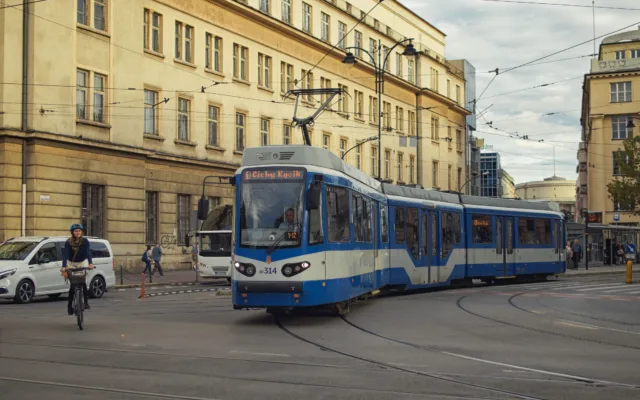
Nowa Huta is easy to reach by tram from the city centre, and the central area is walkable once you arrive. Many visitors prefer a guided tour — on foot or in a vintage car — which brings the planning and the politics to life and reaches scattered sights efficiently. Allow a half-day, or longer if you add the museum and shelters.
Practical tips
- Getting there. A direct tram from the Old Town area reaches Plac Centralny in around 20–30 minutes; from there, explore on foot.
- Cost. Walking the district is free; the museum, shelters and guided tours charge separate fees — check current prices with the operator or the Museum of Kraków.
- Combine it. Nowa Huta works as a half-day trip on its own; pair it with the rest of the city using our 2–3 day itinerary.
- Good to know. This is a residential district — explore it with the same respect you would any neighbourhood where people live.
Frequently asked questions
A district of Kraków built from scratch from 1949 as a model socialist town around a huge steelworks. Its monumental, symmetrical layout is one of the best-preserved examples of socialist-realist urban planning in Europe.
Yes, if you want to see a side of Kraków beyond the medieval centre. It offers striking communist-era architecture and a powerful 20th-century history, and makes an easy half-day trip by tram.
By tram — a direct line reaches the central square, Plac Centralny, in about 20–30 minutes. From there the main area is comfortable to explore on foot.
Plac Centralny and its radiating avenues, the modernist Arka Pana church, the monumental steelworks gate, the Nowa Huta Museum and Cold War shelters, and the Łąki Nowohuckie nature reserve.
Many visitors do. A guided walk or a tour in a vintage car explains the planning and the politics and reaches the scattered sights efficiently — though the district is easy enough to explore independently too.
Allow about half a day for the central area, or longer if you add the museum, the underground shelters or the Arka Pana church.
Comments
No comments yet — be the first on the forum.
Add a comment on the forum →